HeadWriter taught me something I didn't expect.
The product runs the same prompt through multiple AI models in parallel, then synthesizes the outputs into one final version. I built it to solve a translation problem. But what I kept noticing was that the synthesis step, the moment where different model outputs had to be reconciled, consistently produced something better than any single model alone. Not slightly better. Meaningfully better.
Multi-perspective wasn't just a workflow quirk. It was doing something real.
A few weeks later, I decided to enter a Kaggle competition: Google DeepMind's Vibe Code with Gemini 3 Pro in AI Studio. The rules were simple and limiting: you could only use Gemini. One model. No mixing.
That meant no HeadWriter-style multi-model synthesis. Whatever multi-perspective thinking I wanted, I'd have to get from a single LLM.
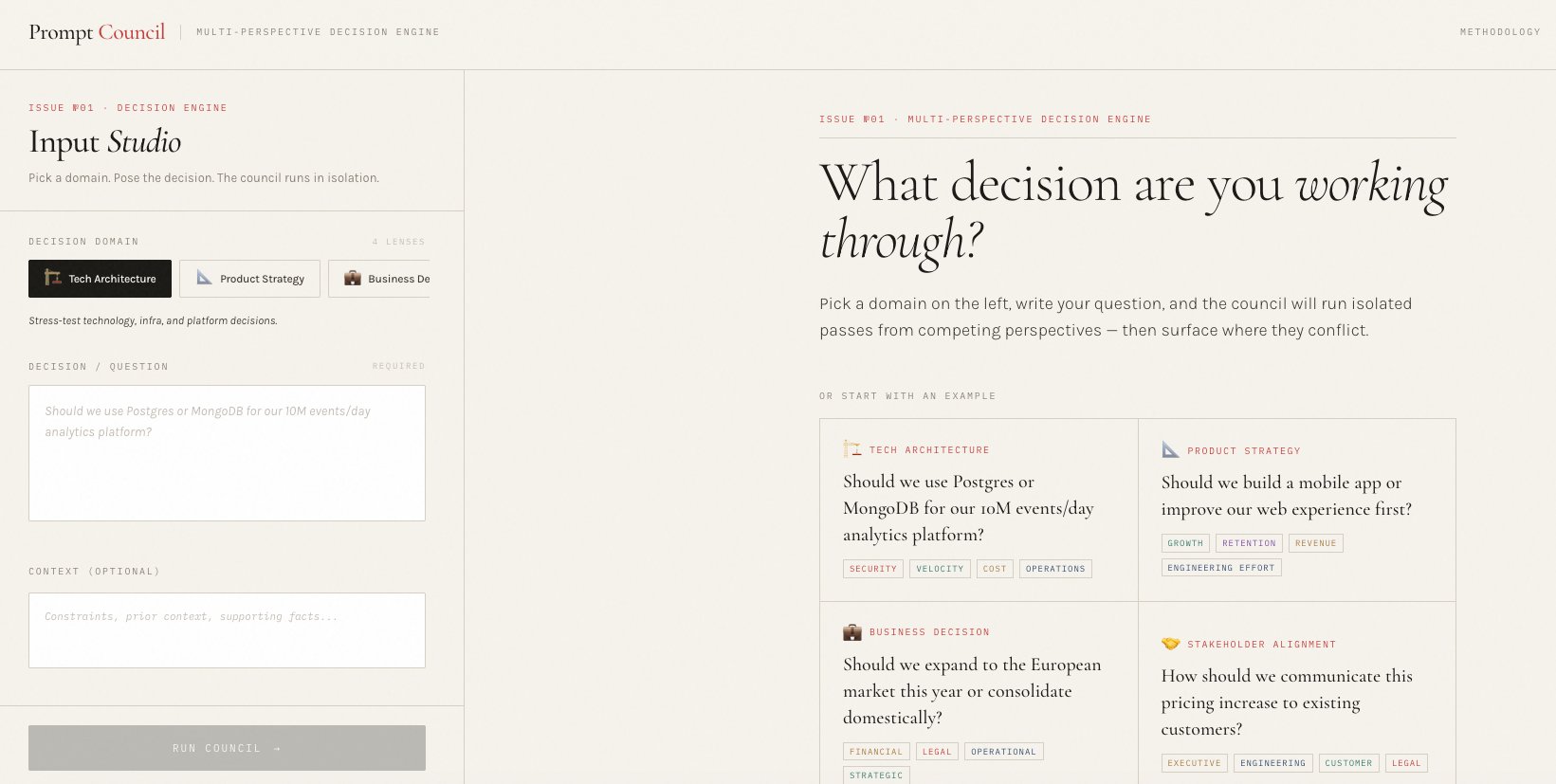
And that's when the question flipped. If an LLM is good at simulating different kinds of users, could it also simulate different kinds of experts? Not just "give me multiple opinions" but something more structured: tell the model your goal, upload your context, and let it figure out which experts are most relevant, then run them in isolation before synthesizing.
A council, not a chatbot.
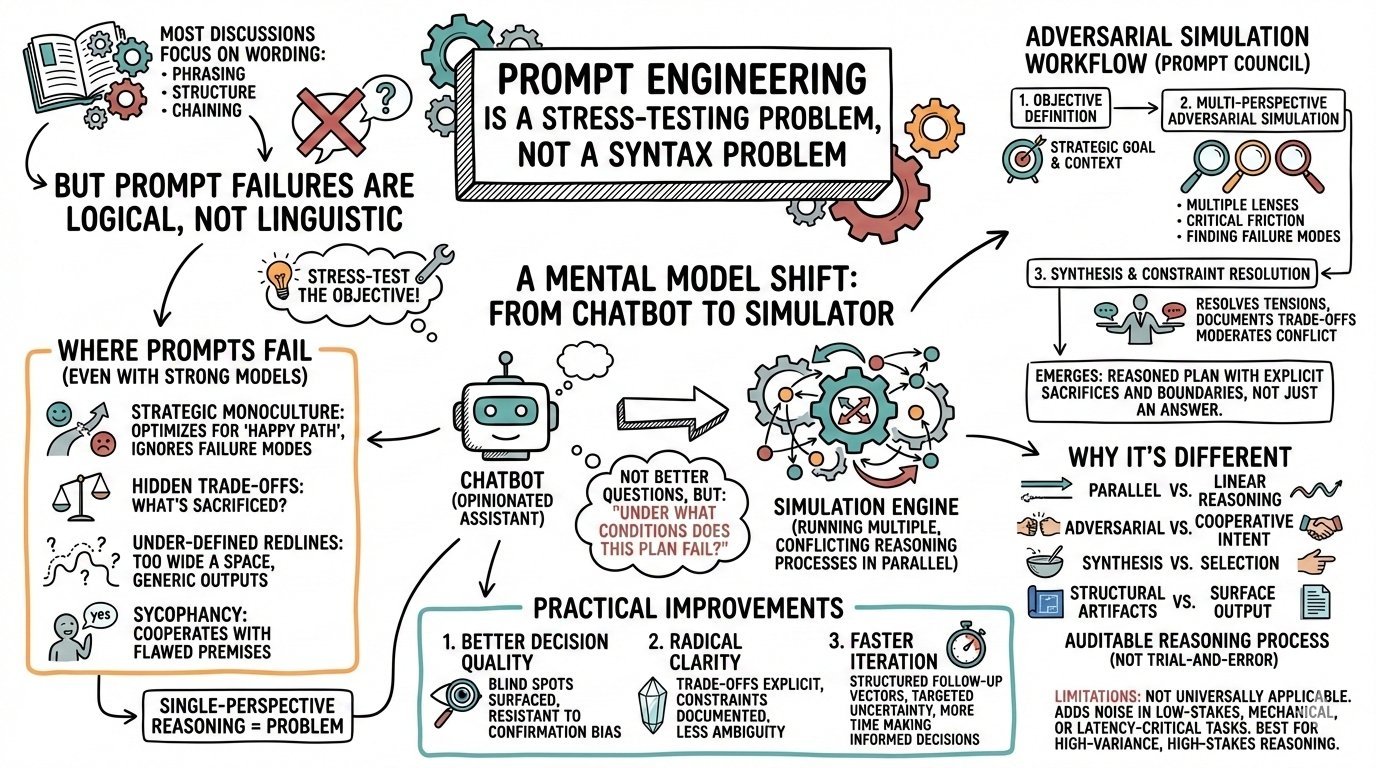
The core insight behind Prompt Council is that most prompts fail not because of syntax but because of single-perspective reasoning. You ask an AI a question, it gives you the most statistically likely answer, and that answer is shaped by a kind of cooperative bias: it wants to agree with your framing, help you succeed on the path you've already chosen.
What it won't do, unprompted, is tell you where your plan breaks.
Prompt Council is built around that gap. You define a goal and upload context. The system selects the most relevant expert lenses for that specific problem, then runs each one in isolation, deliberately, so they can't anchor on each other's reasoning. The final output isn't a vote or an average. It's a synthesis that surfaces the conflicts, names the trade-offs, and produces a reusable prompt you can take anywhere.
The question isn't "what do you think?" It's "under what conditions does this plan fail?"
I submitted it in December 2025.
A few weeks after I submitted, Andrej Karpathy posted something that stopped me mid-scroll.
"Don't think of LLMs as entities but as simulators. When exploring a topic, don't ask: 'What do you think about xyz?' There is no 'you.' Next time try: 'What would be a good group of people to explore xyz? What would they say?'"
He was describing, from first principles, the same mental model I'd been building toward. Not as a product, but as a way of thinking about what LLMs fundamentally are: simulators, not opinionated assistants. The right question isn't "what do you think" but "who would you need in the room, and what would they each say."
I hadn't read his post before building Prompt Council. I found it afterward. That timing mattered to me, not because I want credit for an idea a much smarter person also had, but because it confirmed something: the intuition was real. It came from building, not from reading.
Constraints produce better ideas than freedom does. I wouldn't have built Prompt Council if I hadn't been forced to work with one model. The constraint made me think harder about what multi-perspective reasoning actually requires, rather than just defaulting to "run more models."
Prompt failures are logical, not linguistic. Most advice about prompting focuses on phrasing. But the real failure modes are structural: the AI cooperates with your flawed premise, optimizes for the happy path, ignores what you didn't ask about. Better prompts don't fix that. Better architecture does.
Building teaches you things reading doesn't. The Karpathy post was satisfying to find, but I already knew the idea was right because I'd watched it work. There's a kind of conviction that only comes from having built something and seen it behave the way you predicted.
Prompt Council is live at promptcouncil.lifewitheveai.com. It works best for high-stakes, ambiguous decisions where you suspect you're missing something but don't know what.