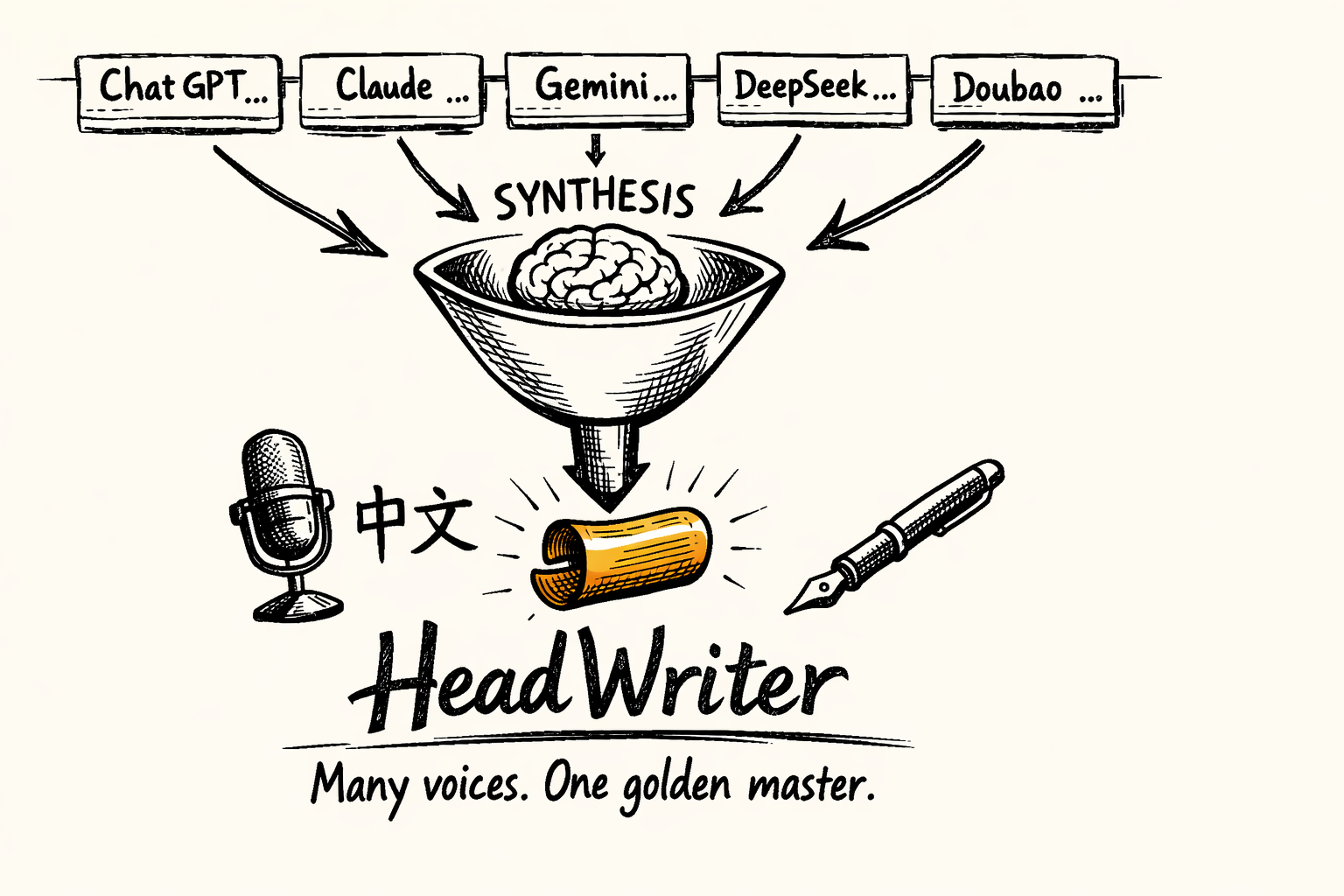
It started with a transcript and a stubborn refusal to translate it by hand.
I was working on the Chinese launch of Reid Hoffman's Possible podcast, converting English transcripts into Chinese. Instead of doing it manually, I decided to lean into AI.
That lasted about twenty minutes.
I ran the transcript through ChatGPT. Then DeepSeek. Then Gemini, Claude, and Doubao. Every output had the same problem: 翻译腔, that stiffness that signals a machine wrote this. No matter how I changed the prompt, I couldn't get rid of it. But each model would nail one or two sentences the others got wrong. GPT captured the rhythm of one line. Claude understood the nuance of another. Gemini got the register right in a third.
So I opened five browser tabs, copied and pasted across all of them, compared versions line by line, and stitched together a hybrid I could actually use.
It worked. It also took forever.
Somewhere in that process a thought surfaced: I am manually doing something AI should be able to do. The synthesis, reading competing outputs, identifying what's strongest, producing a final version, is a reasoning task. Reasoning is what large language models are built for.
That was November 2025.
You write a prompt. Multiple AI models run it in isolation, no model sees what the others produced. A synthesis pass reads all outputs and produces a single version that draws on the strongest elements of each.
The isolation matters. Models that see each other's work tend to converge and average out. HeadWriter keeps them separate, then synthesizes. The result is closer to an editorial decision than a compromise.
It started as a translation tool. It became something broader.
Switching between AI tools to compare outputs is not just a translator's problem. It's a copywriter's problem, a marketer's problem. Anyone who has had three browser tabs open, one GPT, one Claude, one Gemini, trying to decide which version of a sentence is better knows this workflow. HeadWriter removes the manual labor in the middle.
The synthesis is a reasoning task. Reasoning is what large language models are built for.
HeadWriter didn't start with "I want to build an AI writing tool." It started with one transcript, one deadline, and one frustration. Abstract product ideas produce abstract products.
I built HeadWriter using Claude Code for development. The engineering is largely AI-assisted. What I brought was product instinct: knowing when an output feels right, when a UI communicates the right thing, when a feature is solving the wrong problem.
HeadWriter's first version worked and looked like an AI side project. The second version has a new visual identity, a restrained color palette, a hero image that sets a tone. Users read design before they read copy.
HeadWriter is live at headwriter.lifewitheveai.com, free to use with your own API keys.
I still use it for writing, translation, and any moment when I want more than one perspective before committing to a final version. That's the test I apply to everything I build: would I use this if someone else made it?
For HeadWriter, the answer has been yes since the first week.